
Channel Drains for Your Patio or Driveway: A Wirral Homeowner's Guide
Standing water on your new paving? Here's how a channel drain works, where it goes, and how to pick the right one for a Wirral home.
Picture the scene: you've finally had the new patio or driveway laid, it looks brilliant, and then the first proper downpour arrives. Water sits in a puddle against the garage door, or a slippery green patch starts creeping across the slabs where the kids play. It's one of the most common things we get called out to on the Wirral, and nearly always it comes down to one thing: drainage that was never quite thought through.
This guide is from JSB Paving. We're a family-run paving and groundworks team led by Danny in Wallasey, and we build proper drainage into every job. Below we'll explain what a channel drain is, how it works, where it goes on a normal home, and how to choose one. It's written in plain English so you know what to ask for.
Most drainage problems we get called to come down to the wrong drain, in the wrong place, or set at the wrong height, and all three are avoidable.
What is a channel drain? (and why it's also called a linear, trench or slot drain)
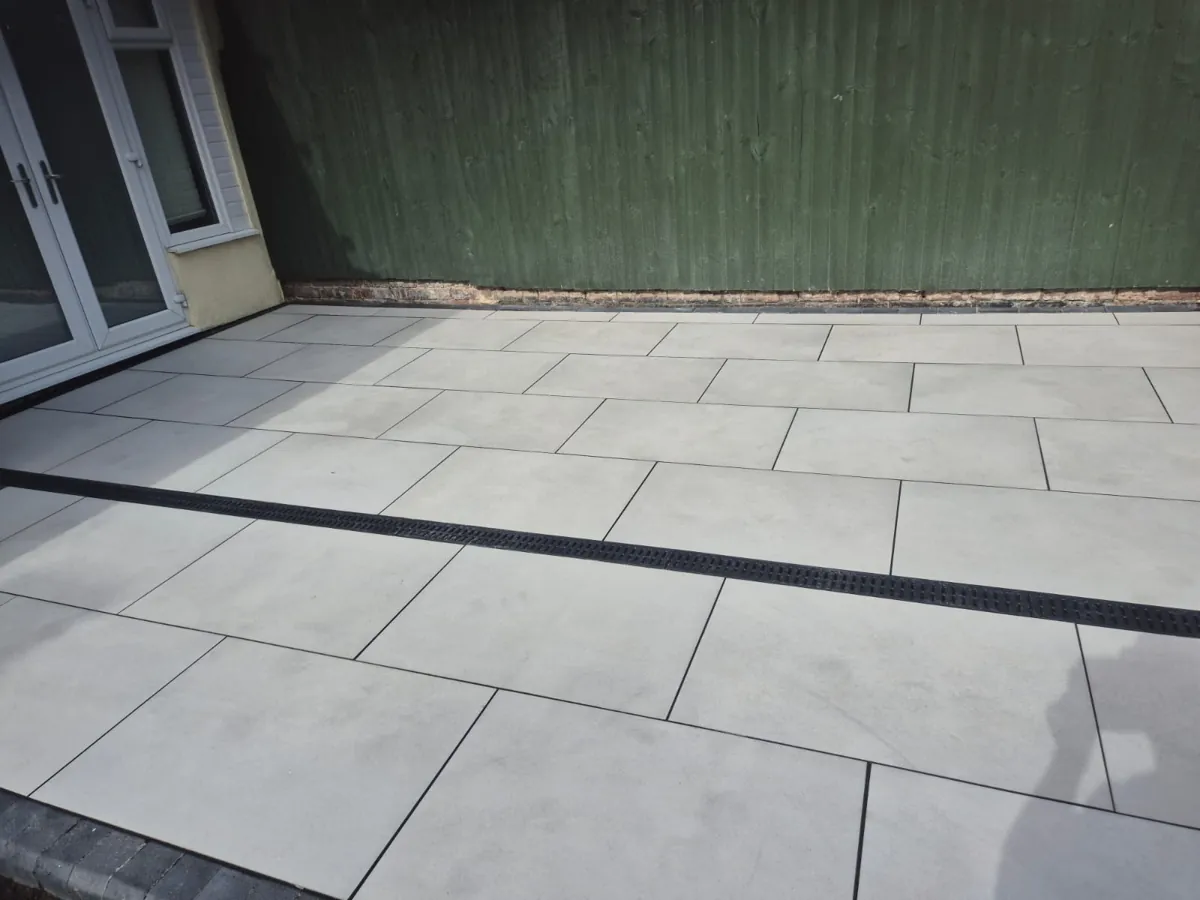
A channel drain is a long, narrow trough set flush into your paving or driveway with a removable grate on top. Rain runs over the grate, drops into the trough below, and is carried away underground to a proper outlet. The clever bit is that it collects water continuously along its whole length, rather than at one single spot like a normal round drain.
If you've been Googling, you'll have seen it called all sorts of things: a linear drain, a trench drain, a slot drain. Don't worry, they're all the same kind of system. You may also see it sold under a well-known brand name, the way people say 'Hoover' for any vacuum. It doesn't mean anything different.
In homeowner terms, it has a few simple parts. There's the channel body (the buried trough, made either of a tough plastic-composite or a heavier concrete-type material), the grate on top (removable, lets water in and keeps leaves out), the outlet (where it joins the underground pipe), and usually a silt trap or little basket near the outlet that catches grit so the pipe further down doesn't clog.
The important reassurance: the water doesn't just soak into the soil under the channel. It leaves through a hidden pipe to a soakaway or the surface-water drain, so it's a proper, connected system, not a hole in the ground. And because the grate lifts straight out, keeping it clear is a quick job with a hose, usually a couple of times a year, and more often if you've got trees dropping leaves nearby.
How does a channel drain actually work?
It works by catching water along a straight line rather than at one spot. As rain sheets evenly across a wide, flat surface, it's picked up all the way along the drain instead of having to run to one corner. That one difference is why channel drains are so good on patios and driveways.
Here's the plain version of what the trade calls 'sheet flow'. On a big level patio or drive, rain spreads out and runs across the whole surface at once. A single point drain would need the entire area sloped just right to funnel every drop towards that one plughole, and getting that spot-on over a wide area is genuinely hard. A channel sits a touch below the paving so water simply falls into it, and gravity then carries it gently along the run to the outlet.
From there it travels through a hidden underground pipe to a legal discharge point: a soakaway or the surface-water drain, never the foul sewer. In one line: a channel is a long line that catches everything crossing it, while a gully is a single plughole that only works if everything runs to it.
The reason we reach for a channel on wide, near-level areas is that you can't reliably slope a big patio hard enough to send every drop to one corner without the finished surface looking or feeling like it's tipping. A line drain lets us keep your paving beautifully flat while still shedding water properly. And that silt trap earns its keep. Grit and leaf mush is what actually blocks these systems, so the trap holds it before it reaches the buried pipe you can't easily get to.
Channel drain vs gully: which does your garden need?
Choose a channel drain when water sheets across a wide area, or runs towards the house or garage along a line. Choose a gully when the problem is one localised puddle or a single downpipe outlet. That's the short answer. Here's how to tell which is you.
If water pools in a long strip, against the house wall, across the mouth of the garage, or along the bottom of a slope, that's a channel job. If it gathers in one dip, or comes off a single rainwater downpipe, a gully may be all you need. A simple test we tell homeowners: go out during heavy rain, or throw a bucket of water down, and watch where it travels. A moving sheet across the slabs says channel. A single gathering puddle says gully.
The two often work together, too. A channel run can discharge into a gully or sump that then connects to the pipe. And on a lot of Wirral drives the real answer is a channel across the bottom, because the fall runs back towards the house or garage. A single gully there just can't swallow water fast enough in a downpour, and it backs up right at the door.
Channel drain
Collects water along its whole length. Good for wide patios, driveways, garage thresholds, and water running towards the house.
Gully
Collects water at one single point. Good for a single downpipe, a low spot, or a small localised puddle.
Why your new patio or driveway needs proper drainage
Drainage isn't an optional extra you can skip to save a few quid. It's the part that decides whether your paving still looks new in ten years. Here are the three reasons it matters, and why we build it in from day one.
Good drainage is buried, so it's the easiest thing to skimp on and the most expensive to fix later. Once the slabs are down you'll never see the drainage again, but it's doing the most important job of all. The classic block-paving failure is a good example: blocks sink because water sat in the sub-base and washed the fine material out from underneath them. It almost never fails at the surface first. It fails underneath, where nobody was looking.
And if you've got a north-facing or shaded garden, as many Wirral homes do, the algae point lands hardest. Those slabs never get enough sun to dry out, so without drainage they're green and lethal by every autumn. Getting it right first time protects your investment, your kerb appeal and your property's value. Digging it up to fix later costs far more than building it in.
1. It protects your house
Stops water pooling against garage doors, door thresholds and the house wall, which is exactly where damp and water getting in begin.
2. It protects the base you paid for
Pooled water works into the joints, softens the aggregate base, and then the paving sinks, shifts, lifts or cracks. It's the classic reason a drive fails a few winters in.
3. It keeps things safe and clean
Standing water grows slippery green algae and moss right where kids and elderly relatives walk, and leaves dirt and staining that ages your lovely new paving.
Where channel drains go on a typical Wirral home
Every home is a bit different, but the same handful of spots come up again and again. Here are the five you'll most likely recognise from your own place.
A couple of insider notes worth passing on. The level-threshold one is the sleeper. Modern bi-folds and flush thresholds look fantastic, but there's nothing to physically stop water at the door, so a discreet slot channel right across it is what keeps that level, step-free access safe and stops water finding its way indoors. On a drive that falls towards the house, we'd rather set the channel a course or two out from the garage door, not tight against it, so there's somewhere to catch the water before it's already at the door in a downpour.
And where the drive meets the pavement, a channel across the bottom also keeps you the right side of the rules. You're not allowed to let your drive water run out onto the public road, and this is how we stop it.
Across a garage threshold
To stop rain running under the up-and-over door and flooding into the garage.
At the foot of a sloping drive
Where a drive falls towards the house or the road, to catch water before it reaches the door or runs off onto the pavement.
Along a patio edge
Where the patio meets the house wall or the lawn, to keep water off the wall and stop the lawn turning to a bog.
At patio & bi-fold door thresholds
For level, step-free access: a slim channel keeps the paving right up at door level without water coming inside.
Where a driveway meets a path
To stop one area draining onto the other.
Choosing the right channel drain: load class explained
There are really only two 'load classes' that matter for a home: A15 for patios and garden paths, and B125 for driveways and light vans. That's it. Everything else is for roads and commercial yards, and you shouldn't be paying for those on your house.
Here's the plain version. A15 is tested to around 1.5 tonnes, which is perfect for patios, paths, courtyards and thresholds where cars don't regularly cross. B125 is tested to around 12.5 tonnes, for driveways, garage entrances and anywhere the car or a delivery van crosses. (Those tonnes are a handy conversion of the technical test figures, not the exact letter of the standard, but they give you the right sense of it.) Most family cars and vans sit comfortably under 12.5 tonnes, so B125 has plenty in hand.
Danny's rule is simple: always at least B125 on a drive, never patio-grade A15 under a car. A car is far heavier than a person, and A15 just isn't built for it. One watch-out to pass on: some plastic slot and 'brick-slot' channels are A15 pedestrian-only. They're great on a patio, but not to be put under the car, and there's a proper vehicle-rated slot version if you still want that hidden look on the drive. If a quote ever pushes C250 or higher for an ordinary family car, that's a flag to ask why. Unless you're regularly parking something much heavier, like a boat, horsebox or large 4x4, it's over-spec, and you shouldn't be paying commercial-yard money for a driveway.
A15: patios & paths
Roughly 1.5 tonnes. For pedestrian areas: patios, garden paths, courtyards and thresholds where cars don't cross.
B125: driveways
Roughly 12.5 tonnes. For driveways, garage entrances and anywhere the car or a light van crosses.
Heavier classes? Rarely for homes
C250, D400 and up are aimed at roads, car parks and commercial yards. For an ordinary family car, B125 is right and heavier classes are over-spec. The one exception is if you regularly park something much heavier, like a boat, horsebox or big 4x4, where C250 can be worth it. If a quote pushes C250+ on a normal drive, just ask why.
Discreet and hidden channel drains that blend into your paving
Yes, you can absolutely get a hidden channel drain. Slot drains and brick-slot channels sit down in the paving joint, so all you see is a thin slot rather than a wide metal grate. Brick-slot channels are made to line up with the joints in block paving or slabs (they suit paving up to around 60mm thick), so the drain more or less disappears into the pattern.
If you'd rather see a grate but want it to look like it was always meant to be there, you've got a lovely range of finishes to choose from. See the options below. The best part is that grates can usually be swapped independently of the channel body, so the same run can be finished differently in different areas: black composite by the block paving, stainless by the porcelain, for example.
How they blend depends on your surface. Stainless steel or a slim threshold-style drain sits almost invisibly against porcelain for a modern finish. Black composite or cast iron suits Indian sandstone and block paving for a warmer, more traditional feel. And on a resin-bound drive the channel usually runs along the edges to catch runoff. Resin is permeable itself, but an edge channel still earns its place, especially where the drive slopes towards the house.
One safety tip worth asking for: heelguard grates. The slots are too narrow to trap a heel, a walking-stick tip, a wheelchair castor or a bike tyre, so they're the one to choose if you've got kids, elderly relatives, wheelchair users or someone in heels in the house. They're kinder on bare feet and paws too. I wouldn't promise they're officially 'paw-tested', but they're a sensible, safer grate all round. And here's the little trick homeowners love: on porcelain or block paving we can drop the slot into the joint line so that, at a glance, you honestly can't tell there's a drain there at all. All the drainage, none of the ugly metal strip.
Black composite
Lightweight, affordable and the common everyday choice. Sits happily with block paving and sandstone.
Cast iron
Traditional, rustic and very tough. Often used on vehicle-rated driveway drains. Warm, textured look.
Galvanised steel
Clean, contemporary and rust-resistant. A crisp modern finish.
Stainless steel
Modern and premium. Pairs beautifully with porcelain for a crisp, near-invisible line.
Slot & brick-slot
Hides the drain down in the paving joint, so there's just a thin slot on show. Blends into the pattern and all but disappears.
Heelguard grates
Narrow slots that won't trap a heel, walking stick, castor or bike tyre. The safe choice with kids, pets or elderly relatives about.
Why professional installation matters
Here's the single most important detail: the grate must sit a few millimetres below the finished paving, so water actually falls into it. Set it flush or proud and the rain simply runs straight past and pools on the surface, which is the exact problem you were trying to solve. (The right amount varies a little, so we say 'a few millimetres below' rather than one fixed figure. The principle never changes.)
Under a driveway there's more to it. The channel is bedded on concrete and haunched, meaning concrete is packed against the sides, not just dropped onto soil or sand. That's what stops it rocking, sinking or cracking when a car drives over it. The whole run also has to fall gently to the outlet and must never 'backfall' (slope away from it), and the surrounding paving should fall towards the drain line so water is actually delivered to it. A silt trap and lift-out grates then make it something you can clean, rather than something that silts up and fails where you can't reach.
The failure mode is simple: a badly-fitted drain can look perfect on day one and simply not drain. Flush grate, no fall, no concrete surround, and you only find out in the first heavy rain, by which point the paving's already on top of it. The commonest cowboy jobs we get called to fix are channels bedded straight on soil, grates set flush, no silt trap or no way to lift the grate, and an outlet plumbed into 'whatever pipe was nearest' without checking where that pipe actually goes. It's all avoidable. It just has to be done right the first time.
Where the water is allowed to go (UK drainage rules made simple)
Do you need planning permission to pave your front garden? In one sentence: paving a front garden over 5 square metres with an impermeable (non-porous) surface needs planning permission, unless you use a permeable surface (gravel, permeable block paving or porous asphalt) or you direct the rainwater to a lawn or border on your own land to drain away naturally.
The reassuring part is that staying within the rules is usually easy. Keep the surface permeable, or simply run the water off to your own lawn, border or a gravel strip, and most well-designed drives sit comfortably within permitted development with no application needed. Worth knowing: the 5 square metre rule is for front gardens facing the road, not automatically your rear patio. You can also repair or replace up to 5 square metres of existing hardstanding without going permeable. And Conservation Areas can change things, so it's worth a quick check.
Then there's where the water is actually allowed to go. In order of preference: into the ground via a soakaway where the soil allows, otherwise to a surface-water drain. What you can never do is run surface water into the foul sewer, out onto the public road or pavement, or onto a neighbour's land without their consent. A soakaway also needs to sit a sensible distance from the house and boundary, commonly around 5 metres from the house.
Two Wirral-specific notes from experience. On heavy clay a soakaway doesn't always cope, so we dig a small test pit to see how fast the ground really takes water before we promise you one. If the clay won't drink it, we plan a proper connection to the surface-water drain instead. And misconnecting rainwater into the foul sewer is both against the law and, when it's found, the homeowner's bill to fix. So it's genuinely worth paying to have the outlet taken to the right place first time, not just the nearest pipe.
Channel Drain FAQs
Do I need planning permission to pave my front garden?
Only if you're paving more than 5 square metres of front garden with an impermeable surface. You can avoid needing permission by using a permeable surface (gravel, permeable block paving or porous asphalt), or by directing the rainwater to a lawn or border on your own land to drain away naturally. Most well-designed drives stay within the rules without any application.
What load class channel drain do I need?
For a home, just two matter: A15 for patios and garden paths (foot traffic, around 1.5 tonnes) and B125 for driveways and light vans (around 12.5 tonnes). Always use at least B125 under a car, never patio-grade A15. Heavier classes are aimed at roads and commercial yards, and a normal family car never needs them, though something much heavier like a boat or a big 4x4 can justify a step up.
Can you get a channel drain that doesn't spoil the look of my patio?
Yes. Slot and brick-slot drains sit down in the paving joint so you only see a thin slot, not a wide grate. On porcelain or block paving they all but disappear. If you'd rather see a grate, you can match the finish (black composite, cast iron, galvanised or stainless steel) to your paving so it looks like it was always meant to be there.
Why does water still pool on my paving even though there's a drain?
Usually because the grate was set flush with or above the paving, so rain runs straight past it, or because there's no proper fall towards the drain. The grate needs to sit a few millimetres below the finished surface, and the paving needs to fall towards it. A drain can look perfect on day one and still not drain; it only shows up in the first heavy rain.
Should I choose a channel drain or a gully?
Watch where the water goes in heavy rain. If it moves as a sheet across a wide area, or runs in a strip towards the house or garage, you want a channel drain. If it gathers in one dip or comes off a single downpipe, a gully may be enough. On many Wirral drives that fall back towards the house, a channel across the bottom is the reliable answer.
How do I keep a channel drain clear?
It's easy. The grate lifts straight out, and the ones we like have a silt basket near the outlet that catches grit and leaf mush. Lift the grate, empty the basket and hose it through. We'd suggest at least once or twice a year, more often if you're under trees or get a lot of leaf fall, and it keeps flowing.

If you've got a puddle against the garage or a slippery green patch on the patio, we'd love to help you sort it properly. We build the drainage into every patio and driveway from day one, so water goes where it should, not against your house, across your garage door or out onto the pavement.
Give Danny a ring and, if you've already got a puddle or a green patch, mention it. That tells us straight away whether it's a channel or a gully job before we even visit.
No spam. Just a real reply from Danny.